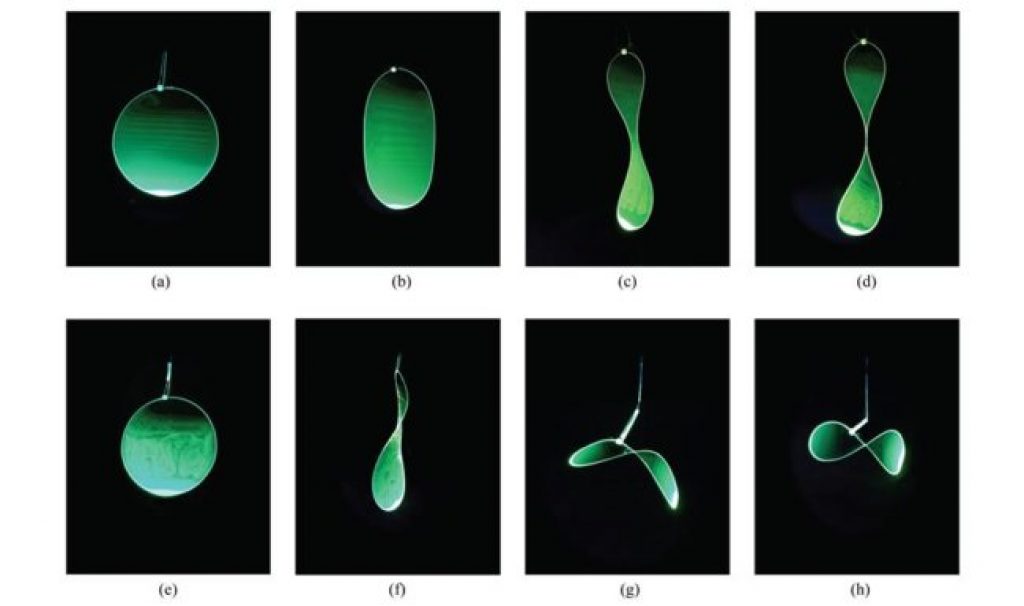
AsianScientist (Dec. 18, 2014) – A paper published in the Proceedings of The Royal Society A examines the energies at work in a closed flexible loop spanned by a soap film. While the underlying experiments are simple enough to be replicated in a kitchen sink, the research generates potentially important questions and changes how we think about different disciplines from material science to vertebrate morphogenesis.
The problem of determining the shape of a soap film that spans a given rigid frame goes back to experiments first conducted by Joseph Plateau in the 1870s. Due to the rigidity of the boundary, only the surface energy of the soap film plays a role in these experiments.
In the experiments that inspired the present study, Okinawa Institute of Science and Technology Graduate University (OIST) Professor Eliot Fried explains that “you have not only the surface tension caused by the soap film, but also energy resulting from the resistance of the loop material to bending and twisting. These energies compete to influence the equilibrium states accessible to the model.”
Previous research focused on a model in which two energies competed: surface tension from a spanning soap film and the flexural resistance of the bounding loop. As the length of the loop increases, the resistance of the bounding loop decreases and experiments. Numerical simulations found a wide range of equilibrium states where the surface tension of the soap films buckles the loop, creating a multitude of different non-flat shapes.
Tackling the next logical problem, Fried’s team at the OIST Mathematical Soft Matter unit examined how energy associated with the resistance of the loop to twisting influences the range of energetically favorable equilibrium states.
Their studies demonstrated both physically and mathematically the points at which these energies overtake one another and act to alter the shape of the loop and the soap film that spans it. Specifically, the new research demonstrates the stabilizing effect of torsional rigidity or resistance to twisting within these models.
The study of loops that can both twist and bend in response to an applied surface tension provides a simple model for various biological systems where elastic filaments or tubes are spanned by membranes. Such naturally occurring structures include high-density lipoproteins, which transport various forms of cholesterol around the body, and the dorsal mesentery, namely the membrane inside the gut which suspends internal structures like the colon.
The 2012 work of Giomi and Mahadevan, which this newest paper continues to build upon, already drew connections to bending and surface tension energies as being both problematic and also a key regulator of vertebrate gut formation. Adding to this the effect of twisting allows future researchers to ask questions about the role such competing energies play in health problems related to highly twisted intestines.
The article can be found at: Biria and Fried (2014) Buckling of a Soap Film Spanning a Flexible Loop Resistant to Bending and Twisting.
——-
Source: OIST.
Disclaimer: This article does not necessarily reflect the views of AsianScientist or its staff.